We've all been there. Standing in endless waiting lines, watching the clock tick away, feeling that familiar surge of customer frustration as minutes turn into what feels like hours. Whether it's at a bank, hospital, or retail store, customer wait time remains one of the biggest pain points in service delivery today.
Here's the thing: unmanaged queues create bottlenecks that drain business productivity, damage your brand reputation, and directly impact your bottom line through revenue loss. In fact, studies show that poor wait time is among the top reasons customers switch to competitors.
Modern queueing theory has evolved far beyond simple first-come-first-served lines. With the right queue management approach, businesses can transform service delays into smooth, predictable customer flow that actually builds trust instead of destroying it.
What Is a Queue Management System?
A queue management system is software that organizes and controls how customers wait for service. QMS software replaces traditional physical lines with digital queuing technology that manages people flow automatically.
Here's what it does: when customers arrive, the system assigns them a place in line digitally. It tracks who's waiting, sends them updates, and tells staff who to serve next. Instead of people standing in crowded lines, they get a digital ticket and can wait comfortably.
Traditional manual processes rely on people physically waiting in line. Digital queuing uses technology for visitor management and service optimization. It's the difference between guessing and knowing exactly what's happening with every customer.
Types of Queue Management Systems
Not all queue systems work the same way. The right choice depends on your space, your service model, and what your customers expect. Here are the main types:
1. Linear Queuing
Traditional linear queues work exactly how they sound: people line up in order and get served sequentially. Simple, fair, but not always efficient. You still see this in grocery stores and fast-food chains where throughput is predictable.
2. Virtual Queue System
Virtual queuing is where things get interesting. Customers don't physically wait in line. Instead, they check in digitally (via mobile check-in, QR codes, or self-service kiosks) and can wait anywhere they want. You've probably experienced this at restaurants that text you when your table is ready.
3. Token Generation System
Ticket systems give people a number and let them track their place in line. This token generation system is common in government offices and service centres. The beauty? No physical line, just a number and freedom to sit down.
4. Appointment Scheduling/Visitor Management Software
Appointment scheduling or visitor management software takes the guesswork out entirely. Instead of managing walk-in chaos, you control the check-in process completely. Workplaces and professional services rely heavily on this system to smooth out demand.
5. Hybrid Service Model
The smartest businesses use hybrid models that combine multiple approaches. Maybe you allow both appointments and walk-ins, or offer online queuing alongside traditional check-in. This flexibility is becoming the standard in 2026.
How a Queue Management System Works
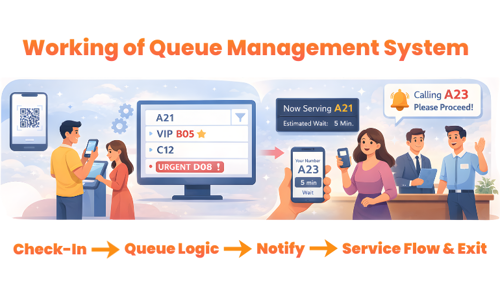
Let's walk through the typical workflow automation step by step:
1. Check-in Process
When someone arrives, they identify themselves through various methods: scanning a QR code, using a touchless check-in kiosk, or booking through a mobile queuing application. The system captures basic information and generates a digital token for the visitor.
2. Queue Logic Engine
This is where the magic happens. Your queue logic engine applies intelligent queue prioritization rules. Maybe VIP customers get faster service, or urgent cases jump the line. The service flow ensures the right people get to the right services at the right time.
3. Real-time Status Updates
Nobody likes uncertainty. Modern systems provide constant real-time tracking through SMS alerts, mobile apps, or digital displays. Customers know exactly where they stand and when they'll likely be served. This single feature dramatically improves wait time perception.
4. Notification Systems
When it's almost someone's turn, automated notifications alert them. Text messages, app pings, visual displays, whatever works. Staff also get notified about who's next and what that person needs.
5. Service Flow and Exit
Once served, the system logs the completion, captures any feedback, and the visitor flow continues smoothly. All of this data feeds back into your analytics dashboard for continuous improvement.
Core Components Every Queue Management System Needs
A comprehensive queue management platform is an ecosystem of integrated components:
- Queue Engine: The core logic that manages all rules and routing.
- Digital Signage: Screens that display current status and wait time tracking.
- Analytics Dashboard: Your control centre showing real-time and historical data insights.
- Reporting Tools: Generate insights on service speed, staff productivity, and patterns.
- API Integration: Connect with your existing cloud platforms and business systems.
- Kiosk Systems: Physical touchpoints for self-service check-in.
- Mobile Apps: Let customers manage their place in line from anywhere.
- Hardware Integration: Sensors, printers, displays that work together seamlessly.
The best cloud-based QMS solutions bring all these pieces together in one unified platform.
Key Problems Poor Queue Management Creates
When line management fails, the consequences ripple through your entire operation:
- Crowding and service chaos create safety issues and terrible first impressions.
- Staff burnout accelerates as employees deal with frustrated customers and peak-time stress.
- Customer churn increases as people simply leave or never return.
- Inefficient flow means you're not maximizing your service capacity.
- Revenue loss happens directly through lost customers and indirectly through productivity loss.
- Operational friction makes everything harder than it needs to be.
Every hour of poor management in your queue is an hour your competitors are winning customers.
Benefits of Implementing Queue Management System
Implementing proper queue management system delivers measurable returns like:
1. Operational Benefits:
- Dramatic improvements in operational efficiency and resource optimization.
- Better workforce planning based on actual demand patterns.
- Enhanced operational transparency for managers and staff.
- Significant ROI of automation through reduced labour costs.
2. Customer Benefits:
- Reduced actual and perceived waiting time.
- Improved service quality and customer experience.
- Enhanced customer loyalty and customer retention.
- Lower churn rate as satisfaction increases.
3. Business Benefits:
- Measurable revenue growth through better capacity utilization.
- Stronger brand reputation through superior service.
- Data insights that can drive continuous improvement.
- Competitive advantage in customer-centricity.
Queue Management System Use Cases Across Industries
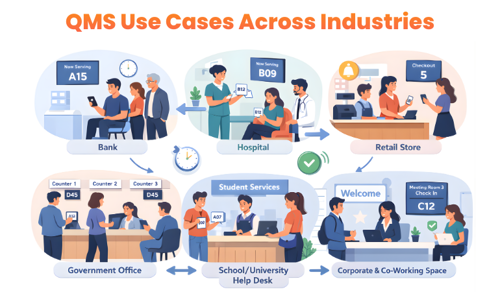
Queue management isn't industry-specific, but can be considered universal. Here's how different sectors apply it:
- Banks and financial services
- Hospital and healthcare
- Retail stores
- Government office
- Schools and universities
- Corporate offices
- Co-working spaces and modern buildings
Each industry adapts the core technology to their specific needs.
Physical Queue vs Virtual Queue
The debate isn't really either/or anymore. It's about choosing the right tool for each situation.
Physical Queues still make sense when:
- Service time is very fast and predictable.
- Customers prefer to see their place in line.
- You're dealing with simple, high-volume transactions.
Virtual Lines excel when:
- Wait times are unpredictable or long.
- Space is limited or you want to eliminate crowding.
- Contactless service and touchless systems are priorities.
- You want to create a queue-less environment where people have freedom.
Most businesses use hybrid service models that offer both on-premise and remote queuing options.
Role of Technology in Queue Management System
Technology integration has transformed what's possible:
- AI enables predictive analytics that forecast demand before it happens.
- QR codes provide frictionless mobile check-in experiences.
- IoT sensors track actual visitor flow through physical spaces.
- Cloud software ensures your system works anywhere, anytime.
- Real-time data feeds dashboards that help staff respond instantly.
- Touchless systems meet both convenience and hygiene expectations.
The future tech trajectory is clear: systems are getting smarter, more predictive, and more seamlessly integrated into broader workplace ecosystems.
Security and Compliance in Queue Management System
With great data comes great responsibility. Modern queue management involves handling sensitive personal identifiable information (PII), which means data privacy is not optional.
Key considerations include:
- GDPR and SOC2 compliance for international operations.
- Secure data storage with encryption and audit trail logs.
- User authentication and identity verification protocols.
- Information security measures that protect visitor tracking data.
- Meeting regulatory compliance and legal standards in your jurisdiction.
- Implementing cloud security standards across all platforms.
Common Queue Management Mistakes to Avoid
Even with great technology, management errors can undermine your results:
- Sticking with manual registers instead of embracing digital transformation.
- Ignoring peak-time planning and getting overwhelmed during rushes.
- Creating system complexity that confuses both staff and customers.
- Poor training issues that prevent teams from using tools effectively.
- Communication gaps that leave customers uninformed.
- Accumulating tech debt by not updating systems regularly.
- Lack of data analysis to drive improvements.
Success requires both the right technology and the right process design.
Final Thoughts on Queue Management System Implementation
The businesses thriving understand that better service starts with respecting people's time. Every minute someone spends waiting is a minute they're judging your business transformation efforts. The technology is mature, affordable, proven and the path forward is clear: embrace digital shift, commit to thoughtful experience, and let data drive continuous improvement.
Your queues are opportunities to demonstrate that you value your customers' most precious resource: their time. Get this right, and everything else becomes easier.